
AI Interior Design Cost: What You’ll Actually Pay in 2026
The short answer is that most AI interior design tools are free to try and $9-$30 a month if you keep using them — a fraction of the $2,000-$12,000 a professional charges per room. This guide breaks down exactly what the free tier gives you, what paid plans include, and when paying is actually worth it.
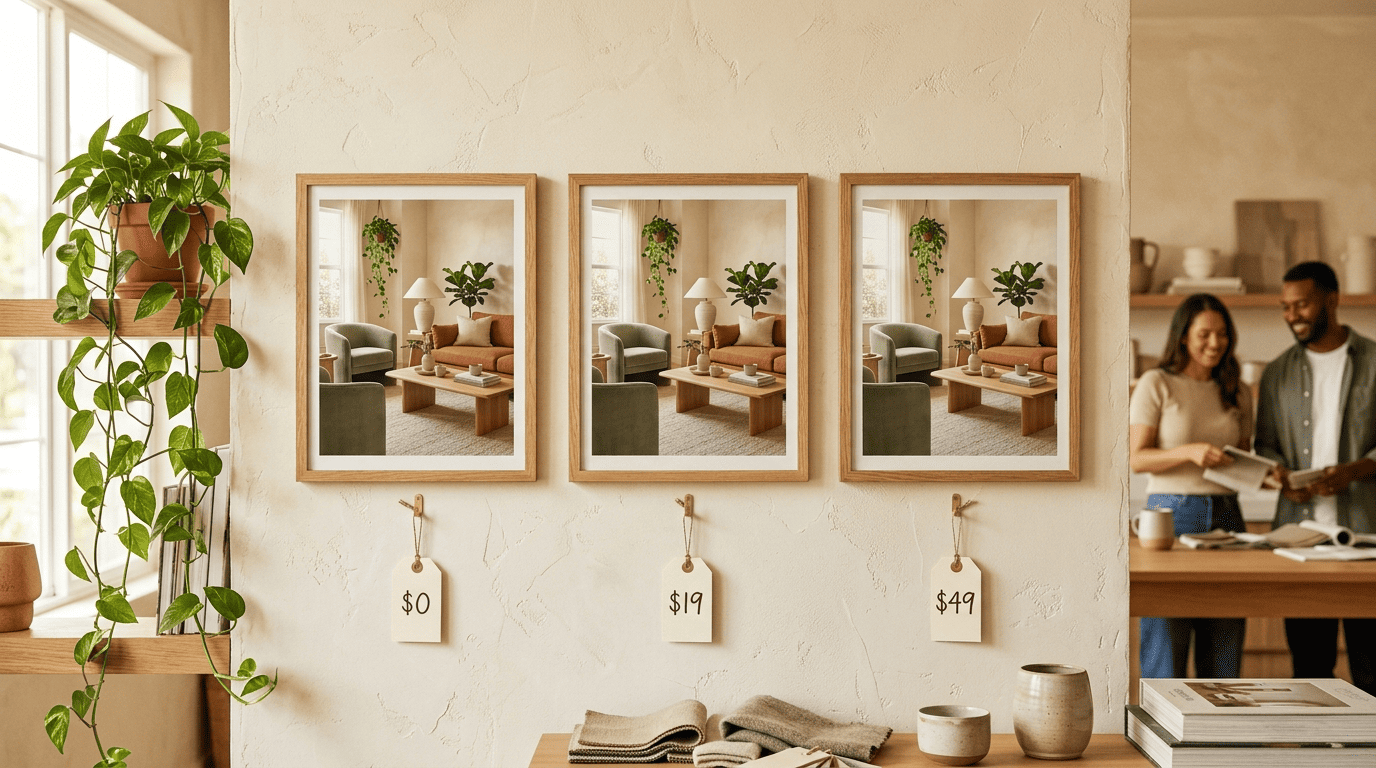
The free tier is genuinely $0, no trial card required, and it covers one or two rooms for most people. Once you cross into serious redesign territory, the paid sweet spot sits at $10-$30 a month, with individual renders running just a few cents apiece — a very different math than hiring a professional interior designer, whose services run into the thousands.

Is AI Interior Design Free? What the Free Tier Really Gives You
Almost every AI interior design assistant on the market ships with a genuine free tier — you upload a photo of a real room, and the tool hands back a redesigned version without ever asking for a credit card. This is the classic freemium model: give away a useful core product, then charge for volume, resolution, or extra features once someone is hooked. For anyone redesigning a single living room or bedroom, the free tier alone is often enough to land on a workable layout and color scheme.
What you get for $0
Practically every AI room design app lets you try the core feature at no cost: upload a photo of your actual space, pick a style, and get a redesigned render back in under a minute. There’s no meaningful barrier to entry — no waiting list, no sales call, no upfront payment. That accessibility is precisely what has made AI interior design tools so popular with homeowners who just want to see what a room could look like before committing money to anything.
The limits of free
Free plans are capped, and the caps follow one of three common patterns:
- Free-credit model — a fixed number of free generations total (typically 3-10), ever.
- Freemium-watermark model — unlimited-feeling generations, but every download carries a visible watermark until you pay.
- Daily-limit model — a cap that resets every 24 hours rather than a lifetime allowance.
On top of whichever model applies, free downloads are usually capped at a lower resolution than paid ones, which matters if you want to print a mood board or share full-size images with a contractor.
What Paid AI Interior Design Plans Cost Per Month
Once the free allowance runs out, paid plans follow a fairly predictable subscription business model: a low monthly fee buys more generations, higher resolution, and a handful of extra features. Pricing is tiered rather than flat, which means the right plan depends almost entirely on how many rooms — and how many revisions per room — you actually need.
The four pricing tiers
Most AI interior design tools cluster into four bands. The table below shows where each tier typically lands and who it tends to fit.
| Tier | Typical price/month | Who it fits |
|---|---|---|
| Free | $0 | Trying the tool, 1-2 rooms |
| Hobby / Starter | $5-$15 | A full home redesign project |
| Professional | $15-$50 | Frequent redesigns, agents, stagers |
| Agency / Enterprise | $50-$200+ | Real estate teams, high-volume use |
Most homeowners doing a whole-house refresh land somewhere in the $10-$30 a month range — enough generations to iterate on every room without hitting a wall.
Real plans compared
To put actual numbers on those bands, a few well-known tools illustrate the spread. Planner 5D runs from a Premium plan around $5-$20 a month up to a Professional tier in the $40-$50 range. RoomGPT’s paid plans span roughly $10-$20 a month for its Pro tier and $25-$35 for its Business tier, on top of a free plan limited to a handful of generations. InteriorAI spans a wider range, with entry plans starting around $29-$39 a month and top-tier plans landing in the $180-$200 range. These figures shift as vendors update pricing, so treat them as a snapshot of the 2026 market rather than a fixed price list.
What Actually Drives the Price
Subscription tiers look arbitrary until you break down what’s actually being metered. Three factors set the price on almost every AI interior design plan:
- Generations per month. This is the primary lever — a plan with 100 renders a month costs meaningfully less than one with 2,000, even from the same vendor.
- Download resolution. Free and entry-level plans often cap downloads well below print quality; higher tiers unlock full-resolution files suitable for sharing with contractors or printing as mood boards.
- Bundled extras. Furniture removal, video walkthroughs, floor-plan conversion, and API access are the features most commonly reserved for mid-to-top tiers rather than entry plans.
Generations, resolution, and extras
Together, these three levers explain almost all of the price spread between a $9 plan and a $150 plan from the same company — it’s rarely the underlying AI model that changes, just how much of it you’re allowed to use and at what fidelity.
Cost per render is the honest metric
Subscription price alone is a misleading number, because it ignores how many renders you actually use. The more honest metric is cost per render, and across AI interior design tools that typically works out to roughly $0.02-$4.00 per image, with many popular tools landing closer to $0.04. If you only need a handful of renders a month, a plan with a low per-render cost and modest total credits can beat a flashier plan with a higher headline price but more included generations than you’ll ever use.
AI vs. a Professional Interior Designer: The Real Cost Gap
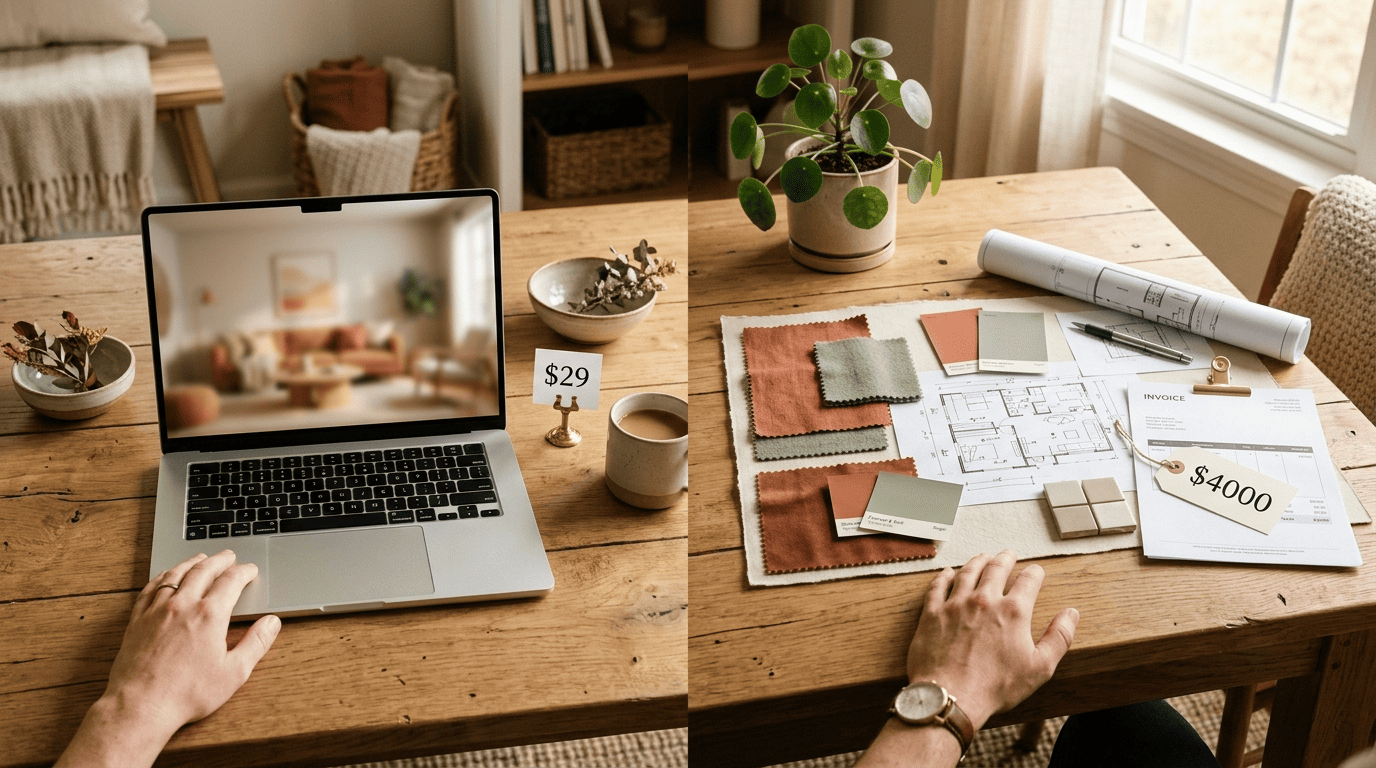
The real question most people are asking isn’t «what does the app cost» — it’s «how does this compare to hiring someone.» On that front, the gap between AI interior design and a human professional is enormous, both in dollars and in time.
What in-person designers charge
A traditional, in-person interior designer typically charges $2,000-$12,000 per room, or bills hourly at $100-$500 an hour. Some work on a percentage basis instead, taking 10-30% of the furniture and materials budget as their fee. According to the U.S. Bureau of Labor Statistics, interior design is a licensed profession with a substantial median annual wage, which helps explain why per-project fees run so high. Timelines match the price: a design phase alone usually takes 4-8 weeks, and once furniture sourcing and installation are added, the full project can stretch to 3-6 months. Online-only design services sit in between, typically charging $100-$500 per room with a turnaround of one to two weeks.
Interior design is the art and science of enhancing the interior of a building to achieve a healthier and more aesthetically pleasing environment for the people using the space.
Wikipedia — Interior design
Where AI wins and where humans win
AI interior design wins decisively on price and speed: a render costs cents rather than thousands of dollars and takes about 30 seconds instead of weeks, which amounts to roughly a 95-99% reduction in cost compared with hiring a professional. Where a human designer still wins is everything AI can’t see or touch:
- Physically measuring a room and catching layout constraints a photo misses.
- Sourcing and negotiating with furniture and materials vendors.
- Managing contractors for renovation or installation work.
- Adapting to genuinely unusual layouts, budgets, or client taste.
The practical strategy most homeowners land on is «AI first, designer if needed»: use an AI interior design assistant to explore styles and layouts cheaply, then bring in a professional only if the project turns out to need hands-on execution.
| Option | Typical cost | Turnaround |
|---|---|---|
| AI interior design | $0.02-$4/render, ~$9-$30/mo | ~30 seconds/render |
| Online design service | $100-$500/room | 1-2 weeks |
| In-person designer | $2,000-$12,000/room | 4-8 weeks (design only) |
Is Paying for AI Interior Design Worth It?
Whether an upgrade pays for itself comes down to a simple comparison: what would you spend on a professional consultation versus what a month of a paid plan costs.
When the free tier is enough
If you’re redesigning one or two rooms and don’t need commercial-grade resolution, staying on the free tier makes sense — there’s little reason to pay until you actually hit its limits. Only upgrade once you find yourself running out of free generations while you’re still actively iterating on a room.

Here’s a quick way to check whether it’s time to upgrade:
- Count how many rooms you still need to redesign this month.
- Check whether you’ve used up your free generations or credits.
- Decide whether you need print-quality resolution, not just a screen preview.
- Ask whether the images will be used commercially (a listing, a rental ad, a portfolio).
- Check whether the watermark on free renders is a dealbreaker for your use case.
- Compare the monthly plan price to a single designer consultation ($200-$1,000).
- If two or more of the above apply, upgrade to the lowest paid tier that covers your generation count.
When to upgrade
Upgrading tends to make sense once several conditions line up at once: you’re redesigning many rooms rather than one or two, you need high-resolution downloads for printing or client-facing use, the images are for a commercial purpose like a rental listing or real estate marketing, or the free tier’s watermark is simply unacceptable for what you’re using the images for. Financially, the math is straightforward — a single paid month on almost any AI interior design plan costs less than one in-person consultation with a professional designer, which typically runs $200-$1,000 on its own.
FAQ
Exploring more of your home? See our guides on planning a room layout and building a color palette.